
Subterranean laboratory (aka sublab, sub-lab)
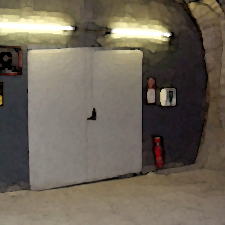 Subterranean laboratories (aka sublabs, sub-labs) are underground facilities, usually built to pursue some specific scientific goal.
Contents |
While the number of sublabs in the Greater Rivertown area is unknown (classified information), guesstimates put the number at 16-18 with a third of those located in the region now called the Northwest Reaches.
The Rawalabad Massacre, Mariussa Bombing, and the Crimson Summer renewed fears about the proliferation of nuclear, biological, and chemical warfare against political, financial, and industrial targets. In a joint effort between the federal government and private industry, subterranean laboratories became very popular for research programs and corporations to hide their research and development practically in plain site.
Using a process known as "covert construction" pioneered in the 2050s and further refined in the 2060s, extensive sublabs could be built underground with very little disturbance, seen or heard, topside. Construction sites would be cordoned off, sometimes draped, while an underground cavern was hollowed out, reinforced, and soundproofed. Drilling and construction equipment would be lowered into the hole and the remainder of construction would take place underground. Equipment was disassembled and returned topside, often via tunneling upward through the floor of warehouses or other temporary structures.
Most sublabs were constructed to pursue specific scientific goals across a variety of fields and industries of both public and private interest. Some nationwide sublab charters include funding for research on:
- Artifical intellgence
- Bio fuels
- Biological warfare
- Chemical warfare
- Cold fusion
- Counter-terrorism
- Cryogenics
- Immunology
- Microwarfare
- Robotics/cybernetics
- Search for Extraterrestrial Intelligence (SETI)
- Solar energy
- Sound energy
- Terraforming
- Wind farms/floating wind farms
While conditions between sub-labs vary somewhat (and some sublabs were reported to be very lavishly furnished) most sub-labs are sparsely decorated and utilitarian in design and decor. Living and recreation spaces were kept separate from work spaces, all of which were typically kept neat and tidy.
Many sub-labs fell into disrepair in the years following the superflu epidemic, as damage to topside infrastructure began to impact the quality of life underground. For example, the destruction of communication satellites and server farms terminated the ability for nearly all the sub-labs in the Greater Rivertown area to reliably access the Internet. Severing the communication link with the outside world increased the sense of isolation and cabin fever, resulting in some inhabitants (especially those who were born underground or went underground at a young age) to lash out at their surroundings, doing more damage and thereby intensifying the problem. Many sub-labs depending on a steady diet of data from topside to complete their research, and losing the communication connection simultaneously ended their reason for being.
Another major factor in a sub-lab's condition is their access to a reliable power source. Though all sub-lab designs had contingency plans for emergency power, few planned on the damage that would result from scavenging. For example, fields of solar panels meant to provide power for sub-labs were dismantled for their parts, or simply destroyed, by scavengers. In other cases, sub-labs drew power from a trio of facilities as part of a redundancy plan, but one was destroyed in a sweeping fire, the second was targeted for a terrorist attack, and the third suffered a failure as a result of the sudden power draw coming from around the region.
The number of people inhabiting a given sub-lab could range from quite small (as few as 6 people) to up to 1,000 inhabitants. As a rule the larger the sub-lab, the more specialized the job duties. For example the Kobolt Industries sub-lab located in the suburbs of Sauklund has a population of 335, with 30 individuals registered as security, 5 registered as teacher/instructor, 15 administrators, along with dozens of dwellers listed alongside specific laboratory duties such as lab director, lab supervisor, lab assistant, etc. In much smaller sub-labs, it would be common for one person to assume multiple roles, such as financial officer, lab supervisor, and head chef.
Even small sub-labs will have a security presence, or the inhabitants will be trained in self-defense. Visitors will likely be seen as potential threats and inhabitants will respond accordingly.
Of the labs in the Northwest Reaches, a few are most notable:
- H+XTROPY Labs explored possibilities for transhumanist futures. The lab employed free thinkers and artists as well as scientists from many different disciplines. The scientists developed a synthetic drug called jack that was intended to fuel utopian thinking in times of crisis.
- Ivan Terra Fabrications funded android research for domestic, entertainment, and military uses and produced several prototypes with strong visual human likenesses but limited vocabularies.
- Microteknique Industries Subterranean Laboratory 7475 focued on microbiology and immunology. While the lab had a broad mandate at the time of its inception, it was one of the first to focus all of its attention on finding an innoculation for the superflu virus.
- "Whitelabs" were top secret laboratories working on confidential projects with untraceable funding.
The contents of a sub-lab will largely depend on the type of work being done and their level of funding. Some sub-labs are quite austere but all will feature sophisticated computer equipment, lab equipment, food, and supplies, though most portable items will be kept in secure vaults.
Most sub-labs are also equipped with state-of-the-art defense equipment, including ceiling-mounted machine guns that can cut waves of intruders in half. However, most labs are also under tight power restrictions and may have powered down certain security systems in order to reroute the energy for more immediate needs.
The Rivertown Compendium draws from the much larger Rivertown Chronicles, a wide assortment of personal narratives and catalog entries of people, places, and things.