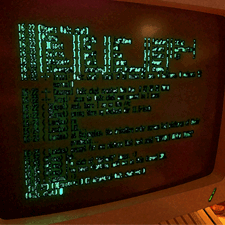
 Betsy Hermann stroked her temples attempting to relieve what had become her daily headache. It was the terminal. Her eyes began to pulse after a minute of staring at the screen, that obnoxious green against the black. Randall had told her that it was never meant for the kind of work she was doing on it, and that instead of complaining she should be thankful he had been able to navigate to her files. She had always disliked Randall and his aversion to hygiene, but he at least in this instance she had to admit he had been useful. She couldn't say the same for Carl.
Carl's mouth was disturbingly close to her ear. "Sometimes you could change the directory. Sometimes you can overlook what you're looking for and sometimes you see it when you change the directory. Sometimes."
Since he hadn't formulated his comment as a question she decided not to dignify it with a response. Changing directories had been the problem. She had done it a hundred times before, backing out of one folder to access a different file set, but she stumbled into a labyrinth of system files and she could not find her way back out. Randall could have returned her to her data faster than she could snap her fingers. Although she was loath to admit it, her current predicament was irrelevant anyway. Her vaccine research had ground to a halt the instant they lost their network connection. A series of technical glitches had imprisoned her. Making progress on this terminal was akin to digging through bedrock with a teaspoon.
Betsy had been a child when her parents took her underground. They meant to survive the plague and violence that had come to define their world. They had instilled in her the belief that she would one day emerge from isolation with a cure, and they all would be heroes. They trained her, and a handful of other specially selected kids (who were selected, she found out much later, based on politics and not ability) on biology, chemistry, organic chemistry, physics. They had powerful computers as their tools, and they had specialists who maintained them.
Now that she was older she understood the sub-lab infrastructure had been a farce.
If a chain is only as strong as its weakest link, Microteknique Industries Sublab 7475 had more weak than strong. Most damningly, the eggheaded, introverted planners had underestimated the pull of the outside world on a generation of children who only saw it in snatches through old films and television shows and the occasional, brief sojourn outside the lab. No one predicted these gifted children would, for kicks, teach themselves how to defeat the security systems meant to contain them. After all, why would they want to leave?
They had all sneaked out at one time or another—even Betsy had gone through a rebellious teenage phase where she went outside seven times in a single year—but then a cadre of them decided to go exploring. Of the eight that left, only one returned. Predictably, strain B of the superflu came back with him. As emotionally hardened as she'd become, she still mentally blocked out the memory of panic the quarantine set off and the hysterical arguments that followed. 70% of the facility contracted the flu and were incarcerated in a space meant for a third of that number. How much of their food stores should be shared with these terminal cases, if any? Should they be allowed to go freely, or should they be put out of their misery? Betsy's parents were among the infected and refused to jeopardize the survivors with their presence. They said their goodbyes to their daughter from behind a four-inch plate glass window both repeating to her like a mantra, "Find a cure." They opened the locks and ventured outside, never to be seen or heard from again. That was ten years ago.
Of those rebellious children only Betsy and Dinesh remained. He had thrown in the research towel long ago and put all of his efforts into getting her into bed, which she assured him would never happen.
That was back when they took their Internet connection for granted. After a year of intermittent outages, the connection dropped for good. Randall could fix the problem by a procedure he called "remote recylcing the server" or some such jargon, but that cure no longer worked. To make matters worse, the network's directory structure seemed to be self-destructing. On principle, Randall refused to use the word virus.
Individual files still existed, but literally in billions of new directories. When asked where the problem originated, he shrugged and mumbled that it could, possibly, conceivably, have come through the connection to one of the other sublabs. Back in the early days Sublab 7475 enjoyed a robust communications network with the other 30-plus sublabs in the region but, like everything, those connections had eroded. Labs went silent without announcement or explanation, many suffering similar containment breakdowns. Curiously, Randall had asked Betsy's permission to lead an expedition to attempt a cold reboot of the server. She held no such power but gave her approval anyway.
He had been gone over three weeks and the network had not been restored. She stopped expecting him to return.
In the last days before their connection expired permanently, Betsy saw hysterical posts announcing that sublabs were being targeted and overtaken by a rogue government operating in the ashes of Rivertown. Microteknique, all corporate-owned facilities, mandated that all sponsored research should be defended with all necessary force. Sublab 7475 had little in terms of security systems compared to some other sublabs, which were practically military-grade bunkers. The whole suggestion that they'd be under threat from outside forces seemed ridiculous but, like so much of her life nowadays, the unthinkable was coming to pass.
She was staring at the flashing cursor and trying to ignore Carl's hot breath when a red strobe light mounted on the wall began flashing. A low siren wailed. Carl snatched the phone next to the monitor and spoke hurriedly into it. His face drained of color, his eyes full of horror. "They're here," he whispered.
"Who?" Betsy asked, still stroking her temples.
"The MPD," he answered. His jaw bobbed more but his mouth made no sound. A voice spoke from the earpiece and Carl jumped, forgetting he still held the phone. He looked at the phone, then looked to Betsy and repeated the question. "What do we do?"
Why ask me? she thought, but she knew the answer. Because the other survivors, weary and worn out from the grind of daily life underground, no longer cared.
Betsy closed her eyes and covered her face as she tried to remember where they stored the medical facemasks. That would be prudent.
She sighed and said through her hands, "We let them in."